

How To Sign Korean In Asl
KSL
Korean Sign Language (KSL) is ane of two sign languages used in South korea. The other is Korean Standard Sign Language (KSDSL). The divergence betwixt the two is that KSDSL is a manually-coded class of Korean, while KSL is a natural sign language with its own vocabulary and grammar distinct from spoken Korean.
History of Korean Sign Language
Because of Korea's colonial history, KSL is similar to Japanese Sign Linguistic communication (JSL) and Taiwan Sign Language (TSL). Nihon occupied Taiwan from 1895-1945 and Korea from 1910-1945, and teachers from Japan established deaf schools in Taiwan and Korea during those occupations. The result was a significant influence of JSL on KSL and TSL, with users of the iii signed languages today having up to 60-seventy percent understandability with i another. This is in stark contrast to the spoken languages of the 3 countries, which are almost completely incomprehensible from one another.
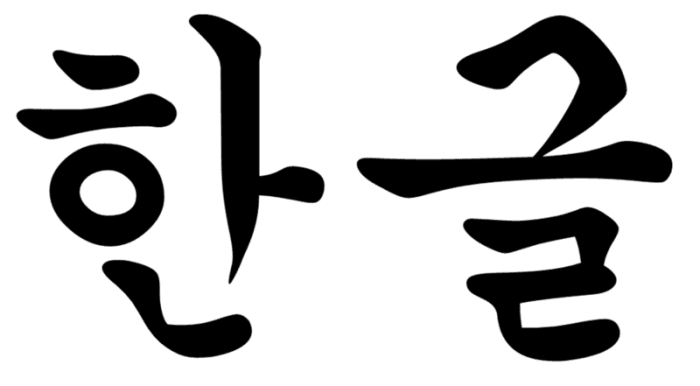
"Hangul", the Korean writing system
public domain via Wikimedia Commons
Korean Sign Linguistic communication and Deaf Education
Oralism (learning to speak and lip-read Korean) has been the dominant fashion of instruction in schools for the deaf in South korea. In the 1980s, KSDSL began to be used along with oralism because of the conventionalities that using a manually-coded form of spoken Korean would improve literacy among deafened Korean students. Contempo studies, nevertheless, accept demonstrated that the ability to use KSL is a stronger predictor of deaf students' literacy than the use of KSDSL. This is consistent with similar studies of American Sign Linguistic communication (ASL) and language conquering in the U.s., which show that fluency in ASL facilitates the acquisition of English language as a second language. This is considering fluency in a natural signed linguistic communication, similar ASL or KSL, provides the proper language foundation for learning a second linguistic communication, while the use of manually coded signs, which are artificial for deaf people, hinders language acquisition.
The 2Bi Approach
Recently, some educators of the deafened in South korea have advocated for a bilingual-bicultural arroyo to deaf instruction, which they call "2Bi." This arroyo emphasizes KSL equally the natural language of deaf people in Republic of korea and has shown some promise: at least i school for the deaf has limited its oral approach and instead incorporates KSL—they fifty-fifty teach KSL to the parents of their deaf students starting in kindergarten. The school has seen higher academic accomplishment among its students than at schools using oral and KSDSL approaches.
The 2Bi model still faces barriers when it comes to full implementation. Many teachers in Korea think that using KSL is the incorrect approach because it is a dissimilar language from Korean. Equally more than teacher grooming programs train futurity educators on the 2Bi approach and the importance of KSL in proper language acquisition, more than schools may adopt education methods that better serve deafened students.
Learn Some Basic KSL Signs
This program is called "Honey's Sign Language Classroom." The hand sign in the background is the aforementioned as the ASL sign for "I love y'all."
Below I will break downwardly the video past run time. Pause at each of the intervals to read my description of the sign beingness shown.
Video Breakdown
0:30 – Here, they are showing the sign for 인사, which means "greeting." The standard sign has the forward move, but one of the hosts shows that y'all tin too plough your hands inward to bear witness two people greeting each other.
1:twenty – KSL uses the same sign for 안녕하세요? (How are you?), 안녕히가세요 (Bye – said to the person leaving), and 안녕히계세요 (Goodbye - said to the person staying backside). The host explains that the KSL sign is a combination of "well" (palm sliding across arm) plus one of the verbs for "to be" (double fist move). (Observe how natural it is to sign "be well" for these greetings, and how awkward it would exist to manually code the verbatim Korean expressions.)
2:xxx – 만나다, "to encounter" – discover that this sign is the same in ASL. When the host shows a few variations, he is explaining what not to do. Brand sure your hands confront each other and your knuckles meet. You don't desire your index fingers to touch or meet.
2:fifty – The contrary of "to encounter" is 헤어지다, which means something like "function" or "say bye."
3:ten - 만나서반갑습니다 means "nice to come across y'all." The signed structure is meet + nice.
3:40 – 기쁘다 means "happy."
3:45 – 즐겁다 ways something like "pleasant" or "pleased."
4:20 – 고맙습니다 means "thank you." Exist sure to bow slightly as they do in the video.
5:x – 미안합니다 means "I'm sorry." This sign looks like the ASL letter "f" touching the brow, brought down to a chopping motility over the back of the opposite paw.
5:30 – 괜찮습니다– means "It'due south ok." This is the sign when the host touches his pinky finger to his chin.
6:05 – 수고 means "effort" or "trouble." This sign also means 수고하다, to make an effort.
half-dozen:20 – 부탁 means "request." The sign also means 부탁하다, to make a request. The neutral form is angled to the speaker's left, but you should point forward when making a asking to someone. You can see the hosts practise this at around 7:00 when they request the audience to report hard.
References
- Se-Eun Jhang, "Notes on Korean Sign Language," in The Handbook of East Asian Psycholinguistics, Book iii, Cambridge University Press (2009), pages 361-375.
- Susan Fischer and Qunhu Gong, "Variation in Eastward Asian sign language structures," in Sign Languages, edited past Diane Brentari, Cambridge University Press (2010), pages 499-518.
- Sung-Kyu Choi, "Deaf Educational activity in South Korea," in Deafened People Around the Earth: Educational and Social Perspectives, edited by Donald F. Moores and Margery Due south. Miller, Gallaudet Academy Printing (2009), pages 88-97.
© 2013 MoonByTheSea
Source: https://owlcation.com/humanities/Korean-Sign-Language
0 Response to "How To Sign Korean In Asl"
Post a Comment