

Tax Wedges Are Larger When
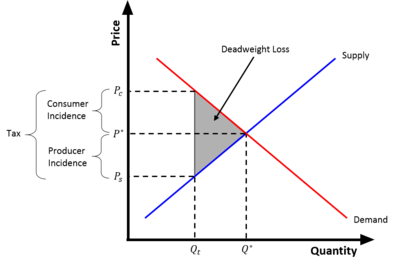
Graph of a tax wedge, showing consumer and producer incidence.
The tax wedge is the deviation from the equilibrium price and quantity ( and , respectively) as a result of the taxation of a good. Because of the tax, consumers pay more for the skillful ( ) than they did earlier the tax, and suppliers receive less for the good ( ) than they did before the tax .[1] Put differently, the revenue enhancement wedge is the deviation between the toll consumers pay and the value producers receive (net of tax) from a transaction.[two] The taxation effectively drives a "wedge" between the toll consumers pay and the price producers receive for a product.


Post-obit the Law of Supply and Need, as the price to consumers increases, and the price received by suppliers decreases, the quantity that each wishes to trade will decrease. After a taxation is introduced, a new equilibrium is reached, where consumers pay more , suppliers receive less , and the quantity exchanged falls . The difference between and will exist equivalent to the size of the per-unit tax.[2]


Implications of a tax wedge [edit]
Deadweight loss [edit]
The filled-in "wedge" created by a revenue enhancement actually represents the amount of deadweight loss created by the tax.[2] Deadweight loss is the reduction in social efficiency (producer and consumer surplus) from preventing trades for which benefits exceed costs.[2] Deadweight loss occurs with a tax because a higher cost for consumers, and a lower toll received past suppliers, reduces the quantity of the skilful sold.[2] Thus, the equilibrium quantity of a taxed good is lower than the equilibrium quantity when the same adept is non taxed. The deadweight loss created by the tax is equal to ,[2] represented past the shaded triangle in the figure.

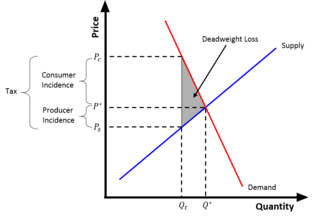
When demand is more inelastic than supply, consumers bear more than of the tax. (Ex. cigarettes)
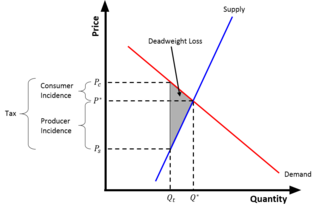
When supply is more inelastic than demand, producers bear more of the revenue enhancement. (Ex. beachfront hotels)
Tax incidence [edit]
There are two types of tax incidence or tax burden created past a revenue enhancement: the statutory incidence of a tax and the economic incidence of a taxation. Typically, a general reference to "tax incidence" refers to the economic incidence of a taxation.
The statutory incidence of a taxation falls on the party, producers or consumers, that has to physically ship a check to the regime in the amount of a tax.[iii] For instance, if a person straight pays his or her income taxation to the government[4] (with no employer withholding), the statutory burden would fall on consumers. If a tax is imposed on the producers of gasoline, however, the statutory brunt would fall on producers.
The economic incidence of a revenue enhancement falls on the political party that bears the bodily cost of the tax. Put some other manner, economic incidence reflects the actual change in an individual's or business firm's resources due to the tax.[2] The statutory incidence of the taxation is irrelevant to the economic incidence of the tax.[2] In fact, the economical incidence is completely determined by the elasticity of supply and need. Typically, both producers and consumers bear some portion of the economical incidence of the tax, merely these portions do not have to be equal. The party with the more inelastic (steeper) bend bears more of the tax.[2] For instance, consumers of tobacco products typically bear more of the taxation on tobacco, considering they are addicted to the production and their consumption is not strongly affected by cost changes (demand is inelastic).[5] Producers behave more of the tax when supply is inelastic; for example, producers of beachfront hotels would bear more of a tax on hotels and accept lower prices for their product, because a change in price would non have a big result on the quantity of beachfront hotels.[5] These examples are illustrated graphically (right). The economic incidence on consumers is equal to , and the incidence on producers is equal to .[2]


Full shifting of a tax occurs when 1 party in a transaction bears all of the revenue enhancement brunt. When demand is perfectly inelastic, the tax burden is fully shifted onto consumers; when supply is perfectly inelastic, the revenue enhancement brunt is fully shifted onto producers.[2] In the long run, however, supply and demand both become more elastic: consumers' preferences for a product can modify (cigarette smokers can quit smoking), and suppliers tin can choose to reduce their investment in, or go out, the market (a hotel concatenation tin can decide to sell its beachfront properties). This means that the economic incidence on consumers and producers tin can change in the long run.[2]
References [edit]
- ^ "Tax Wedge". Investopedia . Retrieved 2009-09-12 .
- ^ a b c d e f g h i j k l Gruber, Jonathan (2013). Public Finance and Public Policy. New York: Worth Publishers. ISBN978-1-4292-7845-4.
- ^ "Glossary of International Tax Terms - Tax Foundation". Tax Foundation. 2012-05-fifteen. Retrieved 2017-04-23 .
- ^ "Welcome to Directly Pay!". world wide web.irs.gov . Retrieved 2017-04-28 .
- ^ a b "Elasticity and tax revenue". Khan Academy . Retrieved 2017-04-28 .

Tax Wedges Are Larger When,
Source: https://en.wikipedia.org/wiki/Tax_wedge
Posted by: baylesthabelloved.blogspot.com
0 Response to "Tax Wedges Are Larger When"
Post a Comment