

Nickel Ii Sulfate Hexahydrate Formula
| |||
 | |||
| Names | |||
|---|---|---|---|
| IUPAC name Nickel(Two) sulfate | |||
| Other names Nickelous sulfate | |||
| Identifiers | |||
| CAS Number |
| ||
| 3D model (JSmol) |
| ||
| ChEBI |
| ||
| ChemSpider |
| ||
| ECHA InfoCard | 100.029.186 | ||
| EC Number |
| ||
| PubChem CID |
| ||
| RTECS number |
| ||
| UNII |
| ||
| CompTox Dashboard (EPA) |
| ||
| InChI
| |||
| SMILES
| |||
| Properties | |||
| Chemic formula | NiSO4 | ||
| Molar mass | 154.75 g/mol (anhydrous) 262.85 g/mol (hexahydrate) 280.86 g/mol (heptahydrate) | ||
| Advent | xanthous solid (anhydrous) blue crystals (hexahydrate) green-blue crystals (heptahydrate) | ||
| Scent | odorless | ||
| Density | four.01 g/cmiii (anhydrous) ii.07 g/cm3 (hexahydrate) 1.948 g/cm3 (heptahydrate) | ||
| Melting point | > 100 °C (anhydrous) 53 °C (hexahydrate) | ||
| Humid point | 840 °C (1,540 °F; one,110 1000) (anhydrous, decomposes) 100 °C (hexahydrate, decomposes) | ||
| Solubility in h2o | 65 g/100 mL (twenty °C) 77.v g/100 mL (30 °C) (heptahydrate) | ||
| Solubility | anhydrous insoluble in ethanol, ether, acetone hexahydrate insoluble in ethanol, ammonia heptahydrate soluble in booze | ||
| Acidity (pGrand a) | four.5 (hexahydrate) | ||
| Magnetic susceptibility (χ) | +4005.0·10−vi cm3/mol | ||
| Refractive index (northward D) | 1.511 (hexahydrate) 1.467 (heptahydrate) | ||
| Structure | |||
| Crystal structure | cubic (anhydrous) tetragonal (hexahydrate) rhombohedral (hexahydrate) | ||
| Hazards | |||
| GHS labelling: | |||
| Pictograms |    | ||
| Signal discussion | Danger | ||
| Hazard statements | H302+H332, H315, H317, H334, H341, H350, H360D, H372, H410 | ||
| Precautionary statements | P201, P261, P273, P280, P308+P313, P501 | ||
| NFPA 704 (burn down diamond) | iii 0 0 | ||
| Flash point | Not-combustible | ||
| Lethal dose or concentration (LD, LC): | |||
| LD50 (median dose) | 264 mg/kg | ||
| Safety data sheet (SDS) | External MSDS | ||
| Related compounds | |||
| Other cations | Cobalt(Ii) sulfate Copper(2) sulfate Iron(Two) sulfate | ||
| Except where otherwise noted, data are given for materials in their standard state (at 25 °C [77 °F], 100 kPa). Infobox references | |||


Nickel(Two) sulfate, or only nickel sulfate, usually refers to the inorganic compound with the formula NiSO4(HtwoO)6. This highly soluble blueish dark-green coloured salt is a common source of the Ni2+ ion for electroplating.
Approximately 40,000 tonnes were produced in 2005. Information technology is mainly used for electroplating of nickel.[1]
In 2005–2006, nickel sulfate was the peak allergen in patch tests (19.0%).[ii]
Structures [edit]

Nickel sulfate hexahydrate under a microscope.
At to the lowest degree seven sulfate salts of nickel(II) are known. These salts differ in terms of their hydration or crystal habit.
The common tetragonal hexahydrate crystallizes from aqueous solution between xxx.7 and 53.8 °C. Below these temperatures, a heptahydrate crystallises, and above these temperatures an orthorhombic hexahydrate forms. The yellowish anhydrous form, NiSO4, is a high melting solid that is rarely encountered in the laboratory. This material is produced by heating the hydrates higher up 330 °C. It decomposes at however higher temperatures to nickel oxide.[1]
Ten-ray crystallography measurements bear witness that NiSO4·6H2O consists of the octahedral [Ni(H2O)vi]2+ ions. These ions in turn are hydrogen bonded to sulfate ions.[3] Dissolution of the salt in h2o gives solutions containing the aquo circuitous [Ni(H2O)6]2+ .
All nickel sulfates are paramagnetic.
Production, applications, and coordination chemical science [edit]
The salt is usually obtained as a by-product of copper refining. It is too produced by dissolution of nickel metallic or nickel oxides in sulfuric acrid.
Aqueous solutions of nickel sulfate reacts with sodium carbonate to precipitate nickel carbonate, a forerunner to nickel-based catalysts and pigments.[iv] Add-on of ammonium sulfate to concentrated aqueous solutions of nickel sulfate precipitates Ni(NH4)two(So4)2·6H2O. This blue-coloured solid is coordinating to Mohr'southward common salt, Fe(NHfour)ii(SOiv)2·6HiiO.[1]
Nickel sulfate is used in the laboratory. Columns used in polyhistidine-tagging, useful in biochemistry and molecular biology, are regenerated with nickel sulfate. Aqueous solutions of NiSO4·6H2O and related hydrates react with ammonia to requite [Ni(NHthree)6]SOfour and with ethylenediamine to give [Ni(H2NCH2CH2NH2)3]SO4 . The latter is occasionally used equally a calibrant for magnetic susceptibility measurements considering it has no tendency to hydrate.
Natural occurrence [edit]
Nickel sulfate occurs equally the rare mineral retgersite, which is a hexahydrate. The 2nd hexahydrate is known every bit nickelhexahydrite (Ni,Mg,Fe)Then4·6HtwoO, which is the monoclinic dimorph of retgersite. The heptahydrate, which is relatively unstable in air, occurs as morenosite. The monohydrate occurs as the very rare mineral dwornikite (Ni,Atomic number 26)So4·HiiO.
Safety [edit]
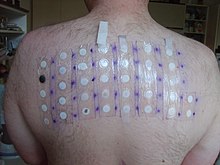
In 2005–06, nickel sulfate was the top allergen in patch tests (nineteen.0%).[2] Nickel sulfate is classified every bit a human carcinogen[5] [6] [7] [8] based on increased respiratory cancer risks observed in epidemiological studies of sulfidic ore refinery workers.[ix] In a 2-year inhalation study in F344 rats and B6C3F1 mice, at that place was no evidence of carcinogenic activity, although increased lung inflammations and bronchial lymph node hyperplasia were observed.[10] These results strongly suggest that there is a threshold for the carcinogenicity of nickel sulfate via inhalation. In a 2-year study with daily oral assistants of nickel sulfate hexahydrate to F344 rats, no evidence for increased carcinogenic activity was observed.[11] The human and animal data consistently signal a lack of carcinogenicity via the oral route of exposure and limit the carcinogenicity of nickel compounds to respiratory tumours subsequently inhalation.[12] Whether these effects are relevant to humans is unclear equally epidemiological studies of highly exposed female workers have not shown agin developmental toxicity furnishings.[13] [14] [15] [16]
References [edit]
- ^ a b c K. Lascelles, L. Yard. Morgan, D. Nicholls, D. Beyersmann "Nickel Compounds" in Ullmann's Encyclopedia of Industrial Chemistry, Wiley-VCH, Weinheim, 2005. Vol. A17 p. 235 doi:x.1002/14356007.a17_235.pub2.
- ^ a b Zug KA, Warshaw EM, Fowler JF Jr, Maibach Howdy, Belsito DL, Pratt Medico, Sasseville D, Storrs FJ, Taylor JS, Mathias CG, Deleo VA, Rietschel RL, Marks J. Patch-test results of the North American Contact Dermatitis Grouping 2005–2006. Dermatitis. 2009 May–Jun;20(3):149-60.
- ^ Wells, A. F. (1984). Structural Inorganic Chemistry, Oxford: Clarendon Press. ISBN 0-19-855370-six.
- ^ H. B. Due west. Patterson, "Catalysts" in Hydrogenation of Fats and Oils 1000. R. Listing and J. W. Male monarch, Eds., 1994, AOCS Press, Urbana.
- ^ IARC (2012). "Nickel and nickel compounds" IARC Monogr Eval Carcinog Risks Hum, Volume 100C: 169-218.
- ^ Regulation (EC) No 1272/2008 of the European Parliament and of the Council of 16 December 2008 on Classification, Labelling and Packaging of Substances and Mixtures, Alteration and Repealing Directives 67/548/EEC and 1999/45/EC and amending Regulation (EC) No 1907/2006 [OJ L 353, 31.12.2008, p. one]. Annex Vi. www.eur-lex.europa.eu/legal-content/en/TXT/?uri=CELEX%3A32008R1272 Accessed July thirteen, 2017.
- ^ Globally Harmonised System of Classification and Labelling of Chemicals (GHS), Fifth revised edition, United nations, New York and Geneva, 2013. PDF at https://www.unece.org/fileadmin/DAM/trans/danger/publi/ghs/ghs_rev05/English language/ST-SG-AC10-30-REv5e.pdf Accessed July 13, 2017.
- ^ NTP (National Toxicology Program). 2016. "Written report on Carcinogens", 14th Edition.; Research Triangle Park, NC: U.S. Department of Health and Human Services, Public Wellness Service. https://ntp.niehs.nih.gov/pubhealth/roc/index-1.html Accessed July 13, 2017.
- ^ International Committee on Nickel Carcinogenesis in Man (ICNCM). (1990). Report of the International Committee on Nickel Carcinogenesis in Man. Browse. J. Work Environ. Health. 16(1): i-82.
- ^ National Toxicology Program (NTP). (1996). Toxicology and Carcinogenesis Studies of Nickel Sulfate Hexahydrate (CAS NO. 10101-97-0) in F344/Due north Rats and B6CF1 Mice (Inhalation Studies). The states DHHS. NTP TR 454. NIH Publication No. 96-3370.
- ^ Heim, Chiliad. Eastward.; Bates, H. M.; Blitz, R. Eastward.; Oller, A. R. (2007). "Oral Carcinogenicity Study with Nickel Sulfate Hexahydrate in Fischer 344 Rats." Toxicol. Appl. Pharmacol. 224(two): 126-137.
- ^ Cogliano, V. J.; Baan, R.; Straif, K.; Grosse, Y.; Lauby-Secretan, B.; Ghissassi, F. E.; Bouvard, V.; Benbrahim-Tallaa, L.; Guha, N.; Freeman, C.; Galichet, L.; Wild, C. P. (2011). "Preventable Exposures Associated With Human Cancers". J Natl Cancer Inst 103: 1827-1839.
- ^ Vaktskjold, A.; Talykova, Fifty. Five.; Chashchin, V. P.; Odland, J. O.; Nieboer, Eastward. (2008). "Spontaneous abortions among nickel-exposed female person refinery workers." Int J Environ Wellness Res. xviii(2): 99-115.
- ^ Vaktskjold, A.; Talykova, L. V.; Chashchin, V. P.; Nieboer, E.; Thomassen, Y.; Odland, J. O. (2006). "Genital malformations in newborns of female nickel-refinery workers." Scan J Work Environ Wellness. 32(1): 41-50.
- ^ Vaktskjold, A.; Talykova, 50. V.; Chashchin, V. P.; Odland, J. O.; Nieboer, Eastward. (2007). "Small-for-gestational-age newborns of female person refinery workers exposed to nickel." Int J Occup Med Environ Health. 20(4): 327-38.
- ^ Vaktskjold, A.; Talykova, L. V.; Chashchin, 5. P.; Odland, J. O.; Nieboer, Eastward. (2008). "Maternal nickel exposure and congenital musculoskeletal defects." Am J Ind Med. 51(eleven): 825-33.
External links [edit]
- International Chemical Safety Carte 0063

Nickel Ii Sulfate Hexahydrate Formula,
Source: https://en.wikipedia.org/wiki/Nickel%28II%29_sulfate
Posted by: baylesthabelloved.blogspot.com
0 Response to "Nickel Ii Sulfate Hexahydrate Formula"
Post a Comment